
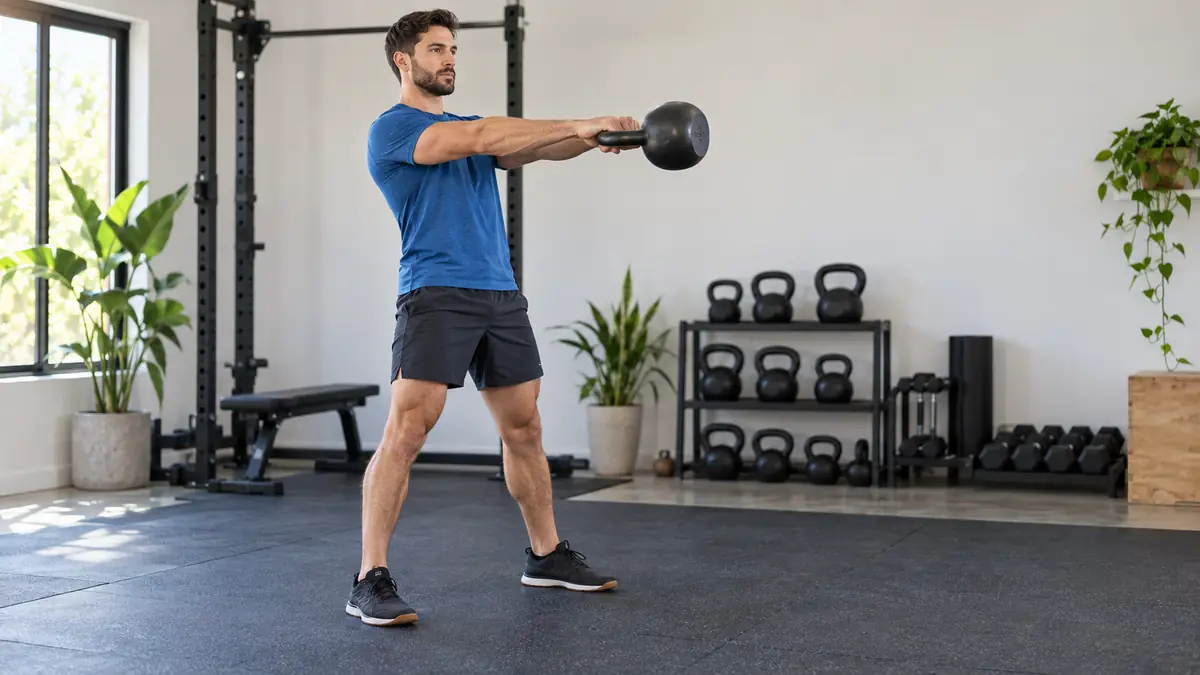
The kettlebell swing mainly trains the glutes and hamstrings, with the muscles along your spine and around your abdomen helping you stay stable. Your lats, shoulders and forearms also work, but they should not lift the kettlebell like a front raise. The movement is driven by a hip hinge and a forceful hip extension. Below, you’ll learn which muscles do what, how to swing with control and how to fit the exercise into a manageable home workout.
What muscles do kettlebell swings work?

The two-handed, chest-height kettlebell swing is primarily a posterior-chain exercise. The posterior chain describes the muscles along the back of the body that help extend the hips and stabilize the trunk. The bell travels upward because the hips accelerate it; the arms act more like a connection than a motor. That distinction is important when deciding whether your form is on target.
Glutes: the main source of hip power
Your gluteus maximus drives the hips toward full extension as you rise from the hinge. Think of finishing in a tall, stacked standing position rather than leaning backward. A hard glute contraction at the top can be a helpful cue, but it is not a reason to thrust your pelvis past a neutral stance.
Hamstrings: hip extension and control
The hamstrings help extend the hips and manage the loaded hinge as the bell swings back. You should feel tension through the back of the thighs without rounding the lower back. If the knees keep bending into a deep squat, the movement shifts away from the characteristic hinge pattern.
Spinal erectors and core: stabilize the trunk
The spinal erectors support torso position while the abdominal wall and obliques resist unwanted arching and rotation. They are working, but the lower back should not be responsible for snapping the kettlebell upward. If repeated swings primarily produce lower-back strain, stop and reassess your hinge, load and fatigue.
Lats, shoulders and forearms: connect and guide
The latissimus dorsi helps keep the upper arm connected to your torso as the bell swings back. The shoulder musculature controls arm position, and the hands and forearms hold the handle. Those muscles contribute without turning the swing into a shoulder raise. The quadriceps assist the small knee extension, but they should not dominate the movement.
How to do a two-handed kettlebell swing
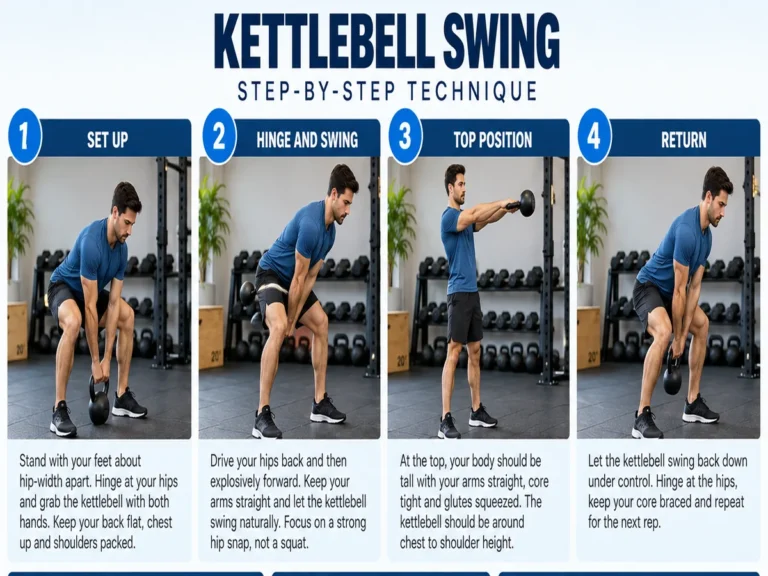
For beginners, begin with the hinge before adding a fast swing. Practice pushing the hips back with a dowel or without weight; then try a controlled kettlebell deadlift. Once you can hinge without losing trunk position, practice the following steps with a bell you can manage confidently.
1. Set up with the bell in front
Stand with feet roughly hip- to shoulder-width apart. Place the kettlebell slightly in front of you. Soften the knees, send the hips backward, and grasp the handle with both hands. Keep the neck aligned with the torso and your feet firmly planted. Do not force the chest high by excessively arching the spine.
2. Hike the bell back
Tilt the bell toward you and pass it between the upper thighs, keeping it close to the body. The hips move back while the knees remain softly bent. The forearms should pass near the inner thighs, not drop toward the floor with straight knees. Inhale or brace in a way that lets you maintain a stable torso.
3. Drive the hips to stand tall
Press through the feet and extend the hips forcefully. Let that impulse float the kettlebell forward; resist pulling up with the arms. In a conventional Russian-style swing, the bell may reach around chest height, but exact height is less important than control. Exhale naturally through the effort without losing your brace.
4. Allow the return and hinge again
Let the kettlebell fall under control. Wait until the arms reconnect toward the torso before hinging back; reaching the hips backward too early may pull the shoulders forward. Repeat while every rep stays consistent. To end, reduce the swing, hinge and set the bell on the floor instead of abruptly letting go.
Five common kettlebell swing mistakes
The first mistake is treating a swing like a squat: excessive knee bend puts the bell low and reduces the hip-hinge emphasis. Second, actively lifting with the shoulders makes the arms tired before the glutes and hamstrings have done their work. Third, leaning back at the top adds unnecessary spinal extension rather than more power. Fourth, letting the bell swing too far below the knees can pull the torso out of position. Finally, continuing fast repetitions when grip, breathing or back position has deteriorated makes the movement less controlled.
A useful self-check is to film a side view: at the top you should stand tall with ribs roughly over pelvis, and near the bottom you should see the hips travel backward. A video cannot diagnose an injury or replace qualified coaching, but it can reveal a swing that has drifted into a squat or a front raise.
Are kettlebell swings good for building muscle?
Swings can contribute to strength, explosive hip-extension practice and conditioning. Whether they add meaningful muscle depends on training history, resistance, effort and overall programming. For people mainly pursuing glute and hamstring hypertrophy, a controlled movement such as a Romanian deadlift, hip thrust or other progressive lower-body lift may be easier to load and track. Use swings as a complement rather than assuming high repetitions replace every strength exercise.
A sensible beginner progression
Start by practicing the bodyweight hip hinge. Next, use a kettlebell deadlift for 2–3 sets of 6–10 deliberate reps while learning stable trunk and foot pressure. When the pattern is consistent, try 4–6 short sets of five swings, resting enough to keep every rep crisp. This is an illustrative starting point, not a universal prescription; some beginners benefit from in-person instruction before adding any ballistic work.
Warm up with several minutes of easy movement, unweighted hinges and comfortable squats. Rest roughly 45–90 seconds between the short swing sets, or longer when breathing and grip have not recovered. Add only a few quality repetitions or one set at a time before considering a heavier bell. Stop for sharp pain, dizziness or loss of control; get individualized advice if you have an injury or medical restriction.
Kettlebell swings vs. deadlifts: when to use each
A deadlift moves the weight from a controlled starting position and is usually easier to pause and reset between reps. A swing is a continuous, faster hinge that asks you to manage momentum. If you cannot yet deadlift with a predictable back and hip position, working on that basic pattern first is usually a practical choice. Our beginner kettlebell exercises guide provides a broader starting point, while the strength training hub covers how hinge exercises fit into a balanced program.
Frequently asked questions
Do kettlebell swings work your abs?
Yes. The abdominal muscles help stabilize the trunk as the bell changes direction. They are not the main source of the swing’s power, and swings should not be treated as a complete replacement for other core exercises.
Should kettlebell swings make your lower back sore?
The lower-back muscles do contribute to stabilizing the torso, but sharp pain or growing strain is not a training target. Stop if you have pain and assess the load and hinge technique; consider a qualified professional when symptoms persist.
Are kettlebell swings more of a leg or back exercise?
They are best understood as a hip-dominant, posterior-chain movement. Glutes and hamstrings provide the principal hip drive, while back and trunk muscles stabilize the movement.
How often should beginners do kettlebell swings?
Start with a frequency that allows your technique and soreness to recover, often one or two sessions a week while learning. Quality and recovery matter more than hitting a specific number of swing workouts. If the movement is new to you, master the basic hinge first.