
The Murph workout is a CrossFit Hero workout built around two one-mile runs and a large block of bodyweight repetitions in between. It honors U.S. Navy Lieutenant Michael P. Murphy, who died in Afghanistan in 2005. The prescribed version is demanding even for experienced athletes, so most people should not treat it as a first-day fitness test.
Knowing how to scale Murph preserves the intent of the challenge while allowing people to practice the movements they can safely control.
The original Murph workout
The official CrossFit Murph benchmark is performed for time:
- Run 1 mile.
- Complete 100 pull-ups, 200 push-ups and 300 air squats.
- Run 1 mile.
The three movements in the middle can be partitioned as needed; for example, experienced athletes sometimes use 20 rounds of five pull-ups, ten push-ups and fifteen squats. CrossFit also lists a weighted vest or body armor as an option in the prescribed workout, but a vest is unnecessary for beginners and can add significant demand.
“For time” does not mean movement quality stops mattering. Breaking sets early is better than pushing through repetitions that you can no longer control.

Why Murph feels so demanding
The opening run raises your heart rate before upper-body and leg fatigue accumulates. Repeated push-ups may become the limiting factor long before the 200th repetition, and the second run can feel very different with tired legs. The total workload is high enough that preparation, pacing and recovery matter more than a fast opening split.
The challenge also depends on access to a pull-up bar and on shoulder tolerance. If pull-ups are not yet available to you, attempting high-volume failed repetitions is neither efficient nor necessary. A stable row variation is a more productive starting point.
A beginner version that follows the official scaling
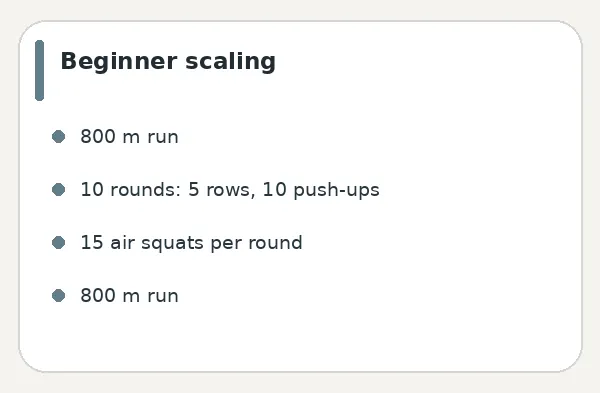
CrossFit publishes a beginner format: run 800 meters, then complete ten rounds of five ring rows, ten knee or elevated-hands push-ups and fifteen air squats, then run another 800 meters. This is still a substantial session and may be too much for someone who has not built basic consistency. Start with fewer rounds if you cannot preserve good form or reasonable breathing.
Practice each movement separately. For ring rows, keep the body aligned, pull the chest toward securely anchored rings and return slowly; exhale as you pull. Stand more upright to make them easier. For elevated push-ups, use a stable support, maintain a controlled torso and exhale while pressing. For air squats, keep feet grounded, sit between the hips within a comfortable range and exhale as you stand. Reduce range or use a chair for support if needed.
A gentler Murph-inspired first session
This is not an official Murph benchmark. It is a low-volume practice session for a healthy beginner who can already tolerate walking and basic bodyweight exercise:
| Part | Work |
|---|---|
| Warm-up | 5 minutes easy walk, shoulder circles and chair squats |
| Start | 5–10 minutes brisk walk |
| Main block | 3–5 rounds: 5 supported rows, 5 incline push-ups, 8 chair squats |
| Finish | 5–10 minutes easy walk |
Rest between rounds until breathing settles. Use a stable anchor for any row and avoid improvised door attachments. If you cannot do the whole session comfortably, halve the rounds. A home-workout routine can help you first build a consistent baseline.
How to prepare over several weeks
Rather than repeating the full benchmark, build gradually. On two nonconsecutive days, practice a small set of rows, push-ups and squats at an effort that lets you stop before failure. Add comfortable walks or runs on separate days as tolerated. Increase repetitions in small steps once your form remains steady. Every few sessions, rehearse a short mixed circuit to learn pacing.
Do not jump straight to a weighted vest to make the workout feel more authentic. If you plan to attempt the prescribed version, make sure you can already complete substantial volume in each movement, can recover from longer sessions, and have a sensible pacing and hydration plan. Stop for sharp pain, dizziness, chest symptoms or unusual distress.
Putting it into practice
Consistency matters more than a perfect session. Select a manageable starting point, keep your repetitions deliberate and review how you recovered before changing the plan. If this topic is new to you, you can explore more adaptable routines in our workout plans section.
Choose an effort you can control rather than pushing through shaky or painful repetitions. If a movement causes sharp pain, dizziness, or unusual symptoms, stop and seek appropriate medical guidance. People returning after injury or managing a medical condition may need individualized advice.
Understand the official beginner version before changing the numbers
CrossFit’s current benchmark page includes an explicit beginner option: run 800 meters, complete ten rounds of five ring rows, ten push-ups from the knees or with hands elevated, and fifteen air squats, then run another 800 meters. This totals 50 ring rows, 100 modified push-ups and 150 squats. The benchmark guidance also says to start the second run no later than the 20-minute mark for that version. These are official scaling instructions, not an invitation to race beyond your current capacity.
If you cannot perform the beginner option with controlled repetitions, reduce the number of rounds or choose a shorter walk-jog session. Clearly label this as an additional personal scaling example rather than “the official Murph.” People with little recent exercise experience are better served by preparing their running or walking tolerance and basic movement skills first.
A simple readiness check
Before attempting any Murph-style session, ask whether you can comfortably complete a moderate walk or run, maintain alignment in repeated elevated push-ups, perform controlled squats and execute a stable horizontal pull. Test these on separate training days rather than exhausting yourself in a single rehearsal. If you cannot do them consistently, build up the individual patterns for a few weeks instead of forcing the benchmark.
The running distance, the number of rounds and the movement difficulty can each be scaled independently. Keep the effort at a level where you can speak a few words and maintain form rather than sprinting the first run. A weighted vest belongs only in the discussion of the prescribed benchmark; it is not necessary for people learning the movements.
Recovery and how to avoid an overly aggressive first attempt
Murph involves an unusually high volume of pulling, pushing and squatting, often under fatigue. Do not schedule a hard upper-body lifting session immediately before or after a first attempt. Warm up with easy movement, shoulder and hip mobility you can control, and a handful of comfortable practice repetitions. Use breaks before your form breaks down, and stop if you develop sharp pain, dizziness or unusual symptoms.
For readers who simply want a home workout, a shorter circuit may deliver more useful practice than a benchmark score. The goal of the beginner version is to keep the movement patterns accessible, not to prove that someone can endure the original workload. Consult CrossFit’s current Murph benchmark for the official prescription and scaling options before sharing specific challenge rules.