
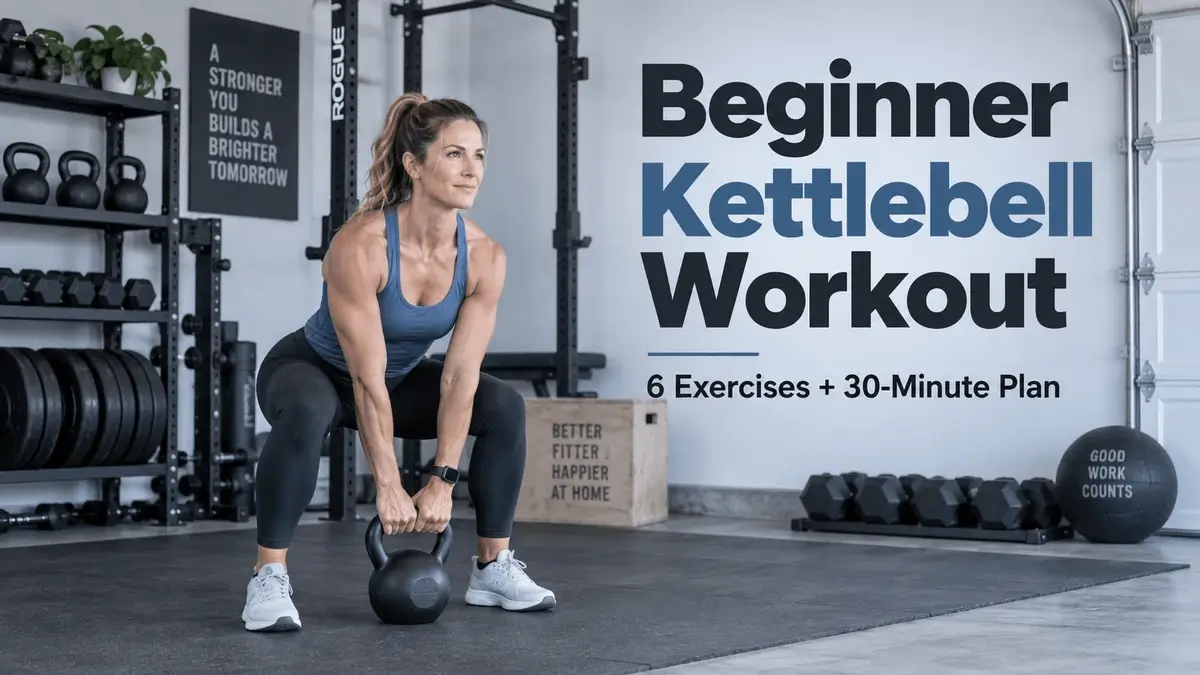
A kettlebell is a practical way to build a simple home strength routine without needing much equipment. For a beginner, the most useful goal is not learning every kettlebell exercise at once. It is getting comfortable with a few basic movement patterns you can repeat with control.
Quick Answer
Start with the deadlift, goblet squat, row, press and farmer’s carry. Add the kettlebell swing only after the hip-hinge pattern feels natural. Choose a weight that lets you finish every rep without rushing or changing your technique.
How to Choose a Beginner Kettlebell
There is no useful one-size-fits-all starting weight based on gender. The right kettlebell depends on the exercise, your training background and how comfortably you can control the movement.
A weight that feels manageable for a deadlift may be too heavy for an overhead press. If possible, test a few sizes. For your first sessions, choose a load that lets you complete the planned reps while keeping the movement smooth and repeatable.
What Beginners Should Learn First
- Hip hinge: push the hips back without turning the movement into a squat. Learn this with the deadlift before practicing swings.
- Squat: use the goblet squat to learn how to keep the weight close and move with control.
- Row and press: build basic upper-body pulling and pressing strength.
- Carry: farmer’s carries are simple and teach you to control the kettlebell while walking.
- Swing later: once the hinge is comfortable, the swing can be added as a faster, more technical progression.
Beginner Kettlebell Exercises
1. Kettlebell Deadlift
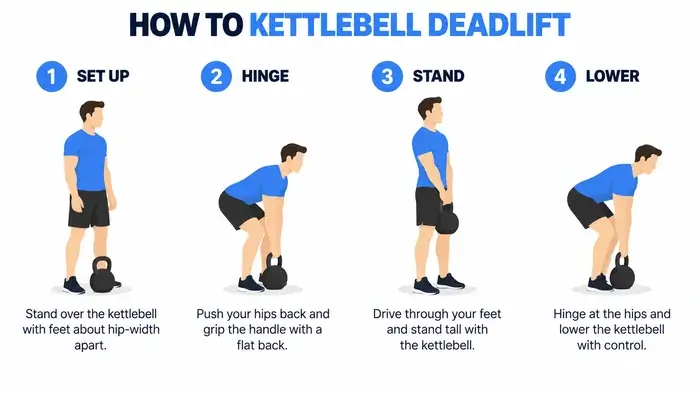
The deadlift is the best place to learn the kettlebell hip hinge. It trains the glutes and hamstrings while teaching you how to move the weight from the floor without turning every rep into a squat.
- Stand with the kettlebell between your feet.
- Push your hips back and bend the knees slightly.
- Grip the handle, brace your trunk, and stand tall.
- Lower the kettlebell by sending the hips back again.
2. Goblet Squat
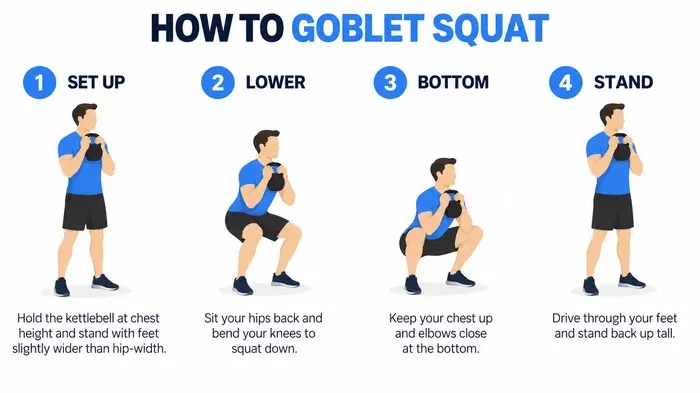
Hold the kettlebell close to your chest and squat to a depth you can control. Keep your feet planted and avoid forcing extra depth if your position starts to collapse.
3. One-Arm Row
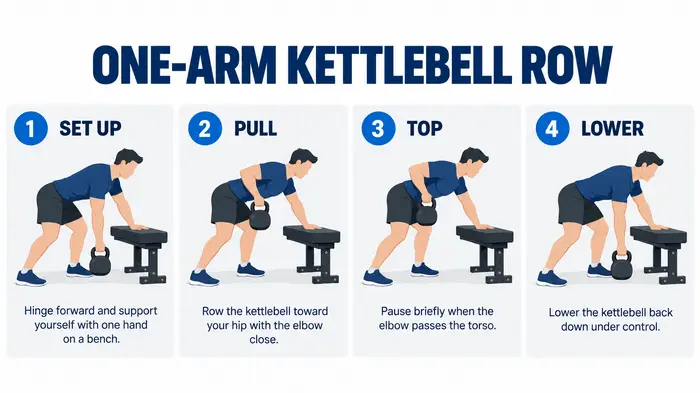
Use the row for simple upper-body pulling work. Hinge slightly, keep your torso steady, and pull the kettlebell toward your hip rather than shrugging it toward your shoulder.
4. Kettlebell Press
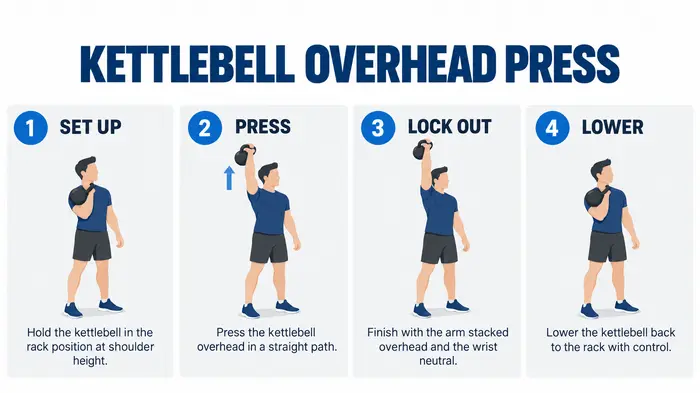
Start with the kettlebell at shoulder height and press overhead without leaning excessively to the side. A lighter kettlebell is often appropriate here than for squats or deadlifts.
5. Farmer’s Carry
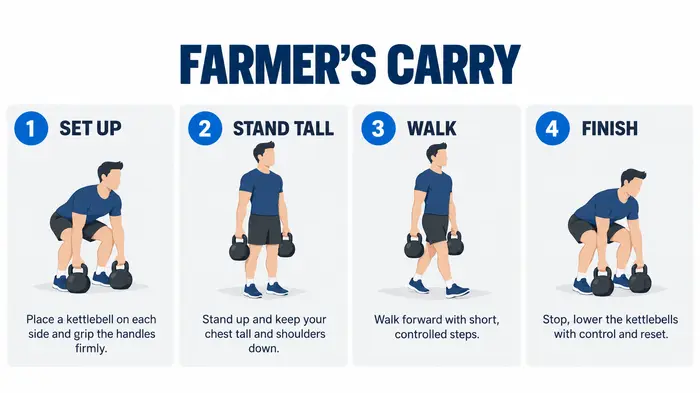
Hold one or two kettlebells at your sides and walk slowly with a tall posture. This is a simple way to train grip, trunk control and loaded walking without learning a complicated technique.
6. Reverse Lunge
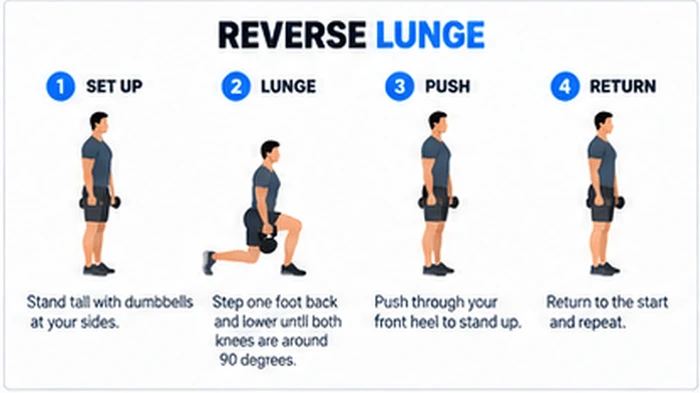
Hold the kettlebell at your chest and step backward into a lunge. Reverse lunges are often easier to control than walking lunges when you are still learning to manage the added load.
When to Add the Kettlebell Swing
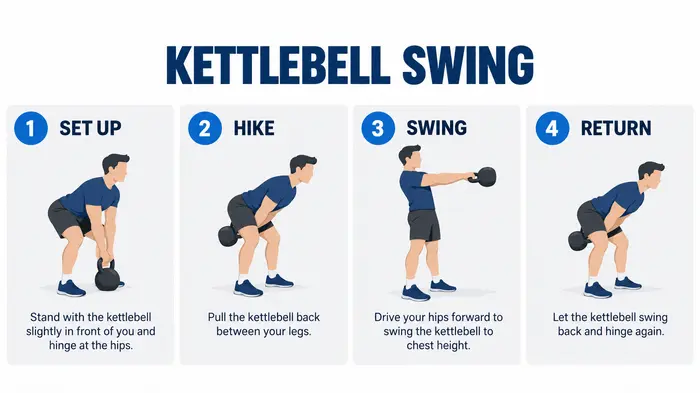
The swing is useful, but it is a faster hip-hinge movement. Learn the deadlift first. When you can hinge smoothly and keep the kettlebell close to your body on the way back, start practicing short sets of swings with a light-to-moderate load.
For the swing, keep the focus on the hip hinge. The kettlebell should be driven by the hips rather than lifted with the arms. Practice short sets and stop when the timing becomes inconsistent.
Exercises to Save for Later
Cleans, snatches, windmills and Turkish get-ups can all be useful exercises, but they are not necessary for your first kettlebell program. They require more coordination, shoulder control or technical practice than the basic movements above.
Build a few weeks of comfortable deadlifts, squats, rows, presses, carries and basic swings first. You can add the more technical movements later if they suit your goals.
30-Minute Beginner Kettlebell Workout
Use this as a simple full-body session. Rest long enough between sets that you can keep the same technique from the first set to the last.
- Kettlebell deadlift: 3 sets of 8-12 reps
- Goblet squat: 3 sets of 8-10 reps
- One-arm row: 3 sets of 8-12 reps per side
- Kettlebell press: 2-3 sets of 6-10 reps per side
- Farmer’s carry: 3 walks of 30-45 seconds
If you are already comfortable with the hip hinge, you can add 2-3 short sets of 10-15 swings at the end. If not, leave the swings out and keep practicing deadlifts.
How to Progress
Do not change everything at once. First add reps within the suggested range. When you can complete those reps with good control across all sets, move to the next available kettlebell or make the exercise slightly harder.
For most beginners, two or three full-body kettlebell sessions per week is enough to practice the movements and make progress without needing a complicated split.
Where to Go Next
For more basic strength work, visit Strength Training. If you want conditioning alongside kettlebells, try the jump rope HIIT workout. For a weekly structure, browse Workout Plans.