

Shadow boxing is simply boxing practice without a bag or partner. You move, punch, defend and work on footwork while imagining an opponent in front of you. It can be used for technique practice, a warm-up, or a short cardio session.
Quick Answer
If you are new to shadow boxing, start with 3 rounds of 2 minutes with 60 seconds of rest. Keep the pace moderate and focus on stance, simple punches and footwork before adding faster combinations.
What Is Shadow Boxing?
Shadow boxing is boxing practice without a bag or partner. You work on stance, punches, defense and footwork while moving through open space. That makes it useful both as skill practice and as a simple conditioning workout.
Why Use Shadow Boxing?
- Technique: practice jabs, crosses, hooks and defensive movements without worrying about hitting a target.
- Footwork: learn to move while keeping your stance balanced.
- Conditioning: longer or faster rounds can make shadow boxing a useful cardio session.
- Convenience: you need very little space and no special equipment.
It is also easy to adjust. A beginner can keep the pace slow and technical, while someone more experienced can use longer rounds, faster combinations and more movement.
Basic Shadow Boxing Technique
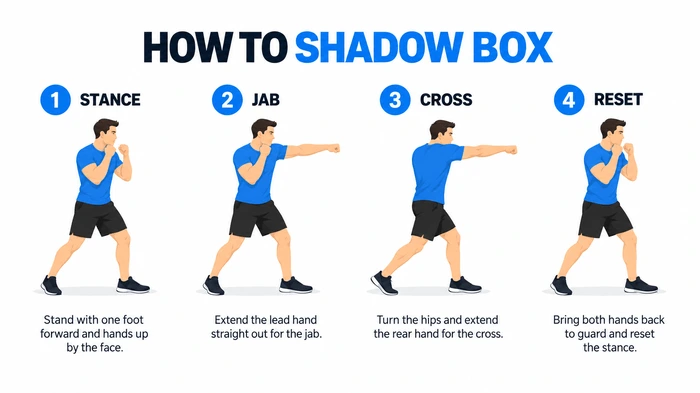
- Stance: keep your feet staggered, knees relaxed and weight balanced enough that you can move in any direction.
- Hands: return each hand toward your guard after the punch instead of leaving the arm extended.
- Jab: use the lead hand for a straight punch and return it quickly.
- Cross: rotate through the rear side while keeping your balance.
- Footwork: take small steps and avoid crossing your feet.
- Defense: add simple slips, steps and guard resets between combinations.
A mirror can be useful for checking whether your hands return to guard and whether your stance stays balanced, but it is not a substitute for feedback from a qualified boxing coach if your goal is to learn boxing technique seriously.
10-Minute Beginner Shadow Boxing Workout
Keep the first sessions simple. You do not need complicated combinations.
- Warm-up: 2 minutes of easy movement, shoulder circles and light punches
- Round 1: 2 minutes — jab, cross, basic steps
- Rest: 60 seconds
- Round 2: 2 minutes — jab-cross, step out, reset
- Rest: 60 seconds
- Round 3: 2 minutes — mix simple combinations with footwork and defense
Keep the pace moderate enough that you can still think about your stance and where your hands are. If technique disappears as soon as you speed up, slow the round down.
How to Progress
Progress by making one part of the session harder at a time. You can add a round, make a round slightly longer, shorten the rest period, or add one new combination. There is no need to add hand weights to make shadow boxing effective.
If technique is the priority, keep some rounds deliberately slow. Faster rounds are useful for conditioning, but speed should not replace control.
Common Shadow Boxing Mistakes
- Only moving the arms: punches should connect with the stance and body rotation.
- Forgetting the feet: use small steps and reset your position instead of standing in one spot.
- Dropping the hands: bring each hand back toward your guard after the punch.
- Going too fast too soon: slow down when balance or technique starts to disappear.
- Adding weights for no reason: if you want strength work, train it separately with controlled resistance exercises.
How to Use Shadow Boxing in Your Week
Shadow boxing can be a short conditioning workout on its own, a warm-up before boxing practice, or a technique session on a lighter day. If you mainly train for general fitness, one or two short sessions per week is an easy place to start.
For another equipment-light conditioning option, try the jump rope HIIT workout. You can also browse Cardio & Conditioning or Workout Plans for ways to fit cardio around strength training.