
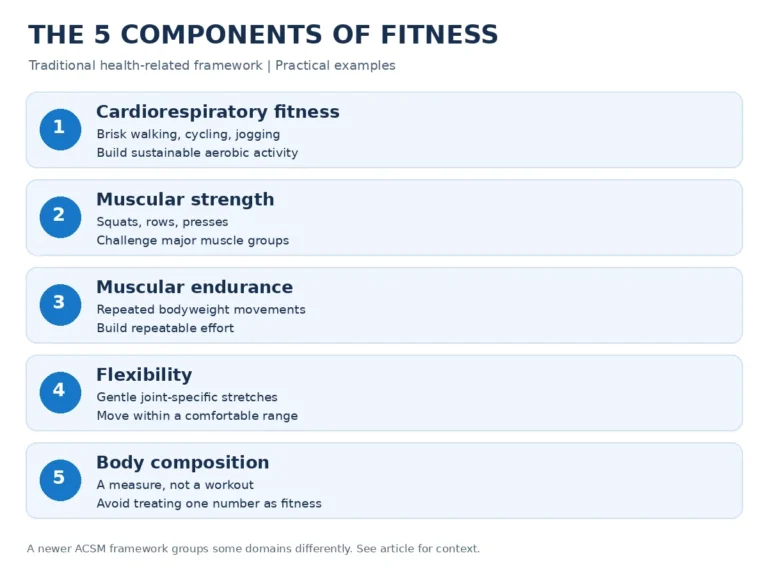
Fitness is not a single score. A person might be comfortable walking for an hour but struggle with heavy grocery bags, or lift substantial weight yet become winded on a long staircase. The traditional five health-related components of fitness help explain why: cardiorespiratory endurance, muscular strength, muscular endurance, flexibility, and body composition. Understanding the difference makes it easier to choose an exercise plan that matches everyday needs rather than chasing one narrow measure.
These five categories remain a common teaching framework, but they are not the only way researchers organize physical fitness. A more recent American College of Sports Medicine (ACSM) roundtable groups fitness into cardiorespiratory fitness, muscular fitness, body composition, neuromotor fitness, and flexibility, with additional subcomponents. This guide explains the familiar five-component model first, then shows how to use it without confusing a classification system with a medical diagnosis.
What are the five components of fitness?
Each component describes a different characteristic. Three concern how you perform physical work, one concerns movement range, and the last describes the body’s composition rather than an exercise skill.
1. Cardiorespiratory endurance: keeping effort going
Cardiorespiratory endurance—sometimes called aerobic or cardiovascular endurance—is your ability to sustain activities that rely on the heart, blood vessels, lungs, and working muscles delivering and using oxygen. Walking uphill, cycling, swimming, and steady jogging are familiar examples. This is not the same as how fast you can sprint: a quick burst and a comfortably sustained effort place different demands on the body.
If you are getting started, choose a pace that raises your breathing but still allows conversation. Try a manageable walk several days a week, then gradually extend its length or choose a slightly more demanding route. The CDC advises adults to aim for at least 150 minutes of moderate-intensity aerobic activity per week—or 75 minutes vigorous activity or an equivalent mixture—plus muscle-strengthening activity on at least two days. These are population-level guidelines, not a rule that every beginner must hit immediately. See our cardio workout guides for approachable options.
2. Muscular strength: producing force
Muscular strength describes the force a muscle or group of muscles can produce. Lifting an object from the floor, standing from a chair while carrying something, and pushing a heavy door all depend on strength. Resistance training improves the ability to handle progressively more challenging loads, even when the exercise does not resemble a maximum-weight lift.
For home training, start with patterns rather than complicated equipment: a squat or chair stand, a hip hinge, a push, a pull, and an appropriate loaded carry. Dumbbells can help, but bodyweight and resistance bands are useful too. A sensible beginner session might include two sets of six to twelve controlled repetitions for each chosen movement, adjusting the range and resistance to leave a few repetitions in reserve. Rest long enough to keep technique consistent and increase the challenge gradually. Our strength training hub explains the basics.
3. Muscular endurance: repeating an effort
Muscular endurance concerns how long a muscle can sustain or repeat work before fatigue limits performance. It overlaps with strength, but the question is different: strength asks how much force you can produce; endurance asks how well you maintain a given effort over time. Repeated sit-to-stands, controlled step-ups, and appropriately modified push-ups can demonstrate this difference.
To build muscular endurance, choose a movement you can repeat without losing form, use a manageable resistance, and gradually accumulate quality repetitions or time. A set of eight careful incline push-ups may be more useful than twenty floor repetitions with an uncontrolled lower back. Do not rush through the work simply to count more. You can combine endurance work with strength sessions rather than giving every quality its own workout day.
4. Flexibility: available movement range
Flexibility refers to the range of motion available around a joint or a set of joints, influenced partly by muscle and other soft tissue properties. It varies from one movement to another: comfortable shoulder movement does not guarantee the same at the hips or ankles. It is also distinct from overall movement control. Being able to reach a position passively is not identical to controlling it under load.
Short, consistent mobility and stretching work is generally easier to maintain than an occasional marathon session. After a walk or workout, try a gentle calf stretch, hip-flexor stretch, and a shoulder or chest stretch where appropriate. Move into a mild stretch, breathe normally, and avoid bouncing or forcing painful positions. People with joint injuries, recent surgery, or persistent pain may need individualized advice rather than generic stretching drills. Explore our flexibility guide for more context.
5. Body composition: a descriptive measure, not a workout
Body composition describes the proportion of fat mass and fat-free tissues, including muscle, bone, and water. It differs from body weight alone: two people at the same scale weight may have different tissue proportions. It is included in the traditional five-component framework, but it should not be treated as a direct measure of skill, personal value, or overall health.
There is no single exercise called “body composition training.” Regular physical activity, resistance training, adequate nutrition, and recovery can influence body composition over time, but changes are highly individual. Home scales that estimate body fat can fluctuate with hydration and measurement conditions, so avoid drawing sweeping conclusions from one reading. Someone can improve aerobic capacity or strength even when body weight stays steady. For most beginners, consistent behaviors and functional progress are better day-to-day targets than a single percentage.
How to train all five without five separate workouts
You do not need a different program for every component. A simple combination of moderate cardio, two full-body resistance sessions, and small amounts of mobility work covers much of the practical groundwork. Body composition is a measurement domain rather than an extra day on the calendar.
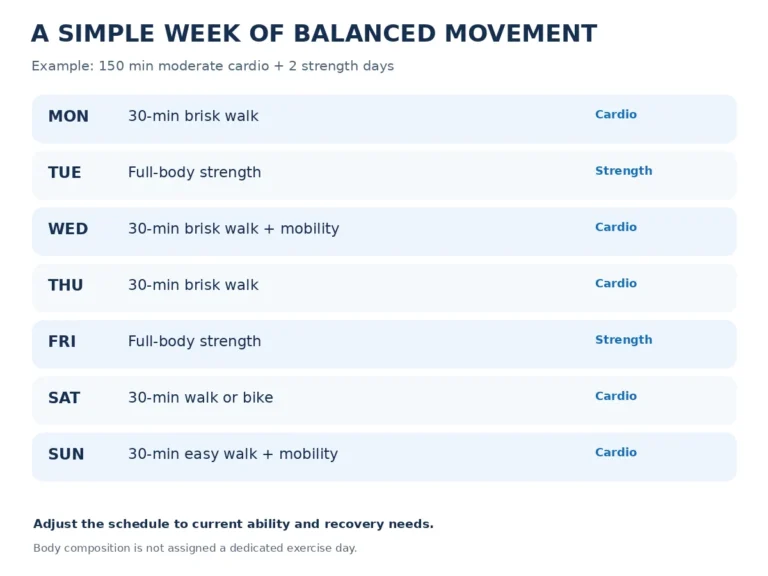
The example schedule supplies 150 minutes of moderate activity spread across five 30-minute sessions, together with two resistance-training days. If you cannot yet manage that much, start with shorter walks and build gradually; some activity is better than none. Pair the strength sessions with major movement patterns such as squatting, hinging, pushing, pulling, and carrying, according to your equipment and ability.
Begin with one or two sets of each movement and leave a day or more between harder sessions while you adapt. Warm up with a few easy minutes of movement before increasing intensity. Add stretching during the cooldown or as a brief separate practice. Our workout plans can help you choose a practical schedule.
How can you tell whether you are improving?
Use simple repeatable observations rather than chasing every available fitness test. For endurance, notice whether a familiar walk feels easier or whether you can maintain it slightly longer. For strength, record the resistance and repetitions of an exercise performed with consistent form. For muscular endurance, record controlled repetitions at the same difficulty. For flexibility, notice whether a meaningful movement becomes more comfortable without pain. Body-composition measures are optional, and none of these informal checks substitutes for a clinical assessment.
Consider tracking only two or three indicators you care about. A person who wants easier hikes might prioritize a regular walk and a step-up exercise; someone focused on everyday lifting might monitor squat, hinge, and carry capacity. If your technique deteriorates or an activity causes sharp pain, back off and reassess rather than forcing a personal best.
How do the newer ACSM components differ?
The ACSM’s updated model recognizes five interconnected groups: cardiorespiratory, muscular, body composition, neuromotor, and flexibility. In that organization, strength and muscular endurance sit within the broader muscular-fitness domain, while neuromotor qualities—such as balance, coordination, and agility—receive explicit attention. Neither framework means balance or coordination should be ignored in a practical routine. You can train them through appropriately chosen single-leg balance exercises, controlled direction changes, or other skillful movement.
The distinction matters when reading different fitness publications: two well-sourced articles may give slightly different “five components” lists because they use different frameworks. For this article, the numbered list follows the traditional health-related categories, and the newer ACSM model provides important context.
Frequently asked questions
Is body composition the same as BMI?
No. BMI compares weight with height and does not directly measure fat or muscle tissue. Body composition attempts to describe different tissues, although available measurement methods vary in accuracy.
Is balance one of the five components of fitness?
Not in the traditional five health-related list presented above. Balance is commonly discussed among skill-related or neuromotor fitness qualities. The newer ACSM framework recognizes neuromotor fitness as one of its five broad categories.
Can beginners improve all five components at home?
Yes, many aspects can be developed with walking, appropriate resistance exercises, and comfortable mobility work. Body composition is not an exercise skill, so improvement there should not be treated as a required outcome of every beginner program.
What is the difference between muscular strength and muscular endurance?
Strength refers primarily to force production; endurance refers to maintaining or repeating muscular work. One exercise can train both, but the emphasis changes with resistance, repetition demands, rest, and your current ability.
Well-rounded fitness is a useful direction, not a test you must pass all at once. Choose movements you can practice consistently, progress gradually, and judge success by how you function and feel—not by a single score.