
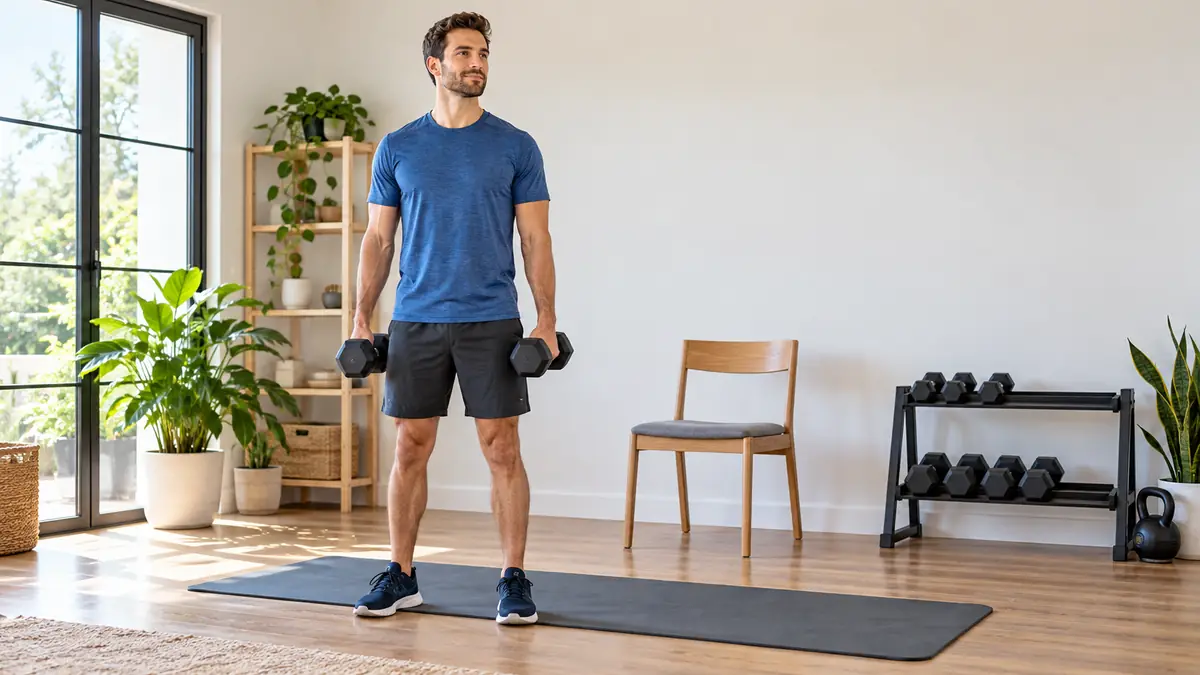
A compound workout routine lets you train several major muscle groups in one session without collecting six machines or spending an hour changing equipment. Squats, push-ups, rows and hip hinges all involve movement at more than one joint. For a practical home session, you can combine them into a full-body plan with little more than a pair of dumbbells and a stable chair. This guide gives you one repeatable session, a no-equipment version and clear ways to make the work easier or harder.
What makes an exercise compound?
A compound exercise uses more than one joint in a coordinated movement. In a squat, the hips, knees and ankles move together. In a push-up, the shoulders and elbows work while the trunk holds position. A dumbbell row combines movement at the shoulder and elbow. Compound does not mean every muscle receives equal training, nor does it mean that isolated movements are useless. It simply describes how the lift is organized.
The appeal at home is efficiency. You can cover a squat pattern, a hinge, a horizontal push, a pull and an overhead push in one session. That provides a more balanced starting point than doing only abdominal exercises or only squats. If you need a broader introduction to weights and basic exercise skills, the Strength Training hub provides related guidance.
Your 30–40 minute compound workout routine
Begin with five minutes of comfortable marching, brisk walking or easy cycling, followed by several unloaded squats, slow hip hinges and shoulder circles. The goal is to practice movement and feel ready, not exhaust yourself before the first set.
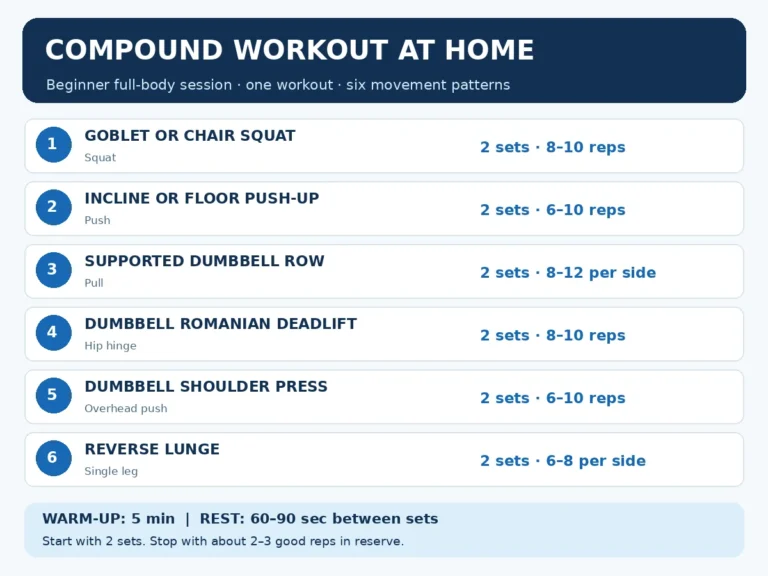
Complete the six exercises in the order shown below. For a first session, use two working sets per exercise; for each one, stop with about two or three good repetitions still possible. Rest 60–90 seconds between sets, or longer until breathing and technique are comfortable. You do not need to rush through this as a circuit.
| Exercise | Beginner dose | Primary movement |
|---|---|---|
| Goblet squat or chair squat | 2 × 8–10 | Squat |
| Incline or floor push-up | 2 × 6–10 | Push |
| Supported one-arm dumbbell row | 2 × 8–12 per side | Pull |
| Dumbbell Romanian deadlift | 2 × 8–10 | Hip hinge |
| Standing dumbbell shoulder press | 2 × 6–10 | Overhead push |
| Reverse lunge or supported split squat | 2 × 6–8 per side | Single-leg |
The table is an example, not a universal prescription. The six movements plus warm-up and breaks often take around 30–40 minutes, but someone learning technique may need more. If your priority is a scheduled three-day dumbbell program rather than one standalone session, use the separate 3-Day Full-Body Dumbbell Workout.
How to perform the six exercises

1. Goblet squat or chair squat
Stand about hip- to shoulder-width apart with feet planted. Hold one dumbbell vertically near your chest, or work without weight. Let your hips and knees bend together as you lower to a depth you can control. Keep your feet grounded and allow your knees to track naturally in line with your toes. Exhale as you stand tall. Avoid dropping rapidly onto a chair or forcing extra depth by rounding your back. For a beginner, touch a stable chair lightly before standing, or squat without weight.
2. Incline or floor push-up
Place your hands on the floor slightly wider than shoulder width, or on a sturdy countertop to make the movement easier. Brace your trunk so shoulders, hips and ankles stay roughly aligned. Bend elbows and lower the chest between the hands without shrugging, then exhale as you press away. If your hips sag or shoulders become uncomfortable, raise the hands to a higher stable surface. NASM describes the push-up as a compound exercise involving the chest, triceps and shoulders.
3. Supported one-arm dumbbell row
Put one hand on a stable bench or heavy chair and stagger your feet, keeping a neutral trunk. With the opposite hand, let the dumbbell hang below the shoulder. Pull the elbow toward the hip without twisting your torso, then lower the weight under control and exhale during the pull. Repeat on both sides. Start lighter if you must jerk the bell up or rotate to complete the rep. See the separate dumbbell weight guide if choosing your first pair.
4. Dumbbell Romanian deadlift
Hold weights by your sides or in front of your thighs with knees softly bent. Send the hips backward while keeping the dumbbells close to your legs. Lower only as far as you can maintain a controlled trunk position and hamstring tension; then press feet into the ground and bring the hips forward to stand. Breathe out through the upward phase. The weights do not have to touch the floor. Common mistakes include turning the hinge into a deep squat, reaching far forward with the bells and arching excessively at lockout.
5. Standing dumbbell shoulder press
Stand tall, with dumbbells at shoulder height and wrists stacked over forearms. Tighten your midsection and press the weights overhead through a comfortable path, then return slowly to the rack. Exhale while pressing and avoid leaning dramatically backward or bumping the knees to throw the load upward. A seated press with back support, or a single light dumbbell held in both hands, may be easier to manage. If overhead movement causes pain, skip this exercise and get individual guidance instead of pushing through.
6. Reverse lunge or supported split squat
Stand beside a wall or stable countertop if balance needs help. Step one foot backward, bend both knees within a comfortable range and keep most of the pressure through the front foot. Push through the front leg to stand, then switch sides. Exhale as you rise. Avoid a tiny backward step that forces an awkward knee position or wobbling through the bottom. A supported stationary split squat is a simpler alternative because both feet stay in place.
How to adapt the workout without a full set of dumbbells
If you own only one dumbbell, hold it at your chest for squats and do one-arm rows on each side. Perform the Romanian deadlift holding that bell in both hands or use an unloaded hip hinge to learn the pattern. The push-up and lunge require no equipment. For the shoulder press, use the same dumbbell one arm at a time if you can control the load and maintain a steady trunk.
With no dumbbells at all, use chair squats, incline push-ups, a hip-hinge drill, split squats and a wall-supported overhead reach. The weak point is the pulling pattern: pulling against an anchored towel or improvised door setup is risky unless the anchor is designed for that purpose. If you have no safe pulling equipment, leave rows out temporarily instead of trusting an unstable household attachment. A resistance band with a manufacturer-approved anchor can provide a suitable alternative. The small-space equipment guide covers practical options.
How often should you repeat it?
For a beginner, try the session twice a week on nonconsecutive days, leaving time to recover. On the first week, even one complete session is a reasonable start if training is new. The CDC recommends muscle-strengthening activity on at least two days per week for adults, alongside aerobic activity. Its recommendation is about overall weekly activity, not a requirement to perform this exact routine twice.
When you complete every prescribed repetition smoothly for two or three sessions, increase a rep or two within the listed range; only then consider a small weight increase. If recovery becomes difficult, keep the load unchanged or reduce a set. A simple training note with weights, reps and how demanding each set felt is more useful than chasing soreness. Moderate effort and repeatable technique are better targets than exhaustion.
If you train other days, avoid stacking this session right after a demanding full-body strength workout. Your legs, shoulders and back still need recovery, even though this plan uses modest equipment. Walking, easy cycling or other comfortable movement can fit between strength days.
Mistakes that make a compound routine less effective
The first error is picking exercises that all repeat the same pattern. Three squat variations and two lunges do not replace a pushing and pulling movement. The second is going too heavy before a hinge or row feels natural. Choose weights that allow you to pause and control the return, not just complete the upward half. The third is turning every session into a race; resting enough to perform another quality set usually supports technique better than competing with a stopwatch.
A final mistake is believing you must use all six exercises even if one hurts. Discomfort related to hard effort is different from sharp pain, dizziness or unusual symptoms. Stop when warning signs appear. If you have relevant health conditions, a clinician or qualified exercise professional can help adjust the training plan.
Compound workout FAQ
Can beginners do compound exercises at home?
Yes, if the exercises and loads suit their current ability. Start with supported or bodyweight variations, a manageable number of sets and enough rest to maintain technique.
Do compound workouts build muscle without a gym?
They can provide a muscle-strengthening stimulus, particularly when you gradually challenge the movements. Results depend on consistency, adequate recovery, nutrition and whether the available resistance becomes demanding enough over time.
Is it better to do compound or isolation exercises?
Neither is automatically better for every goal. Compound exercises efficiently cover several movement patterns, while isolation work can give additional attention to a particular muscle. Beginners can start with compound movements and add targeted work if needed.
How long should a full-body compound workout take?
This six-exercise session typically takes around 30–40 minutes with the suggested sets and rests. A shorter version using four movements can be reasonable if time is limited.